
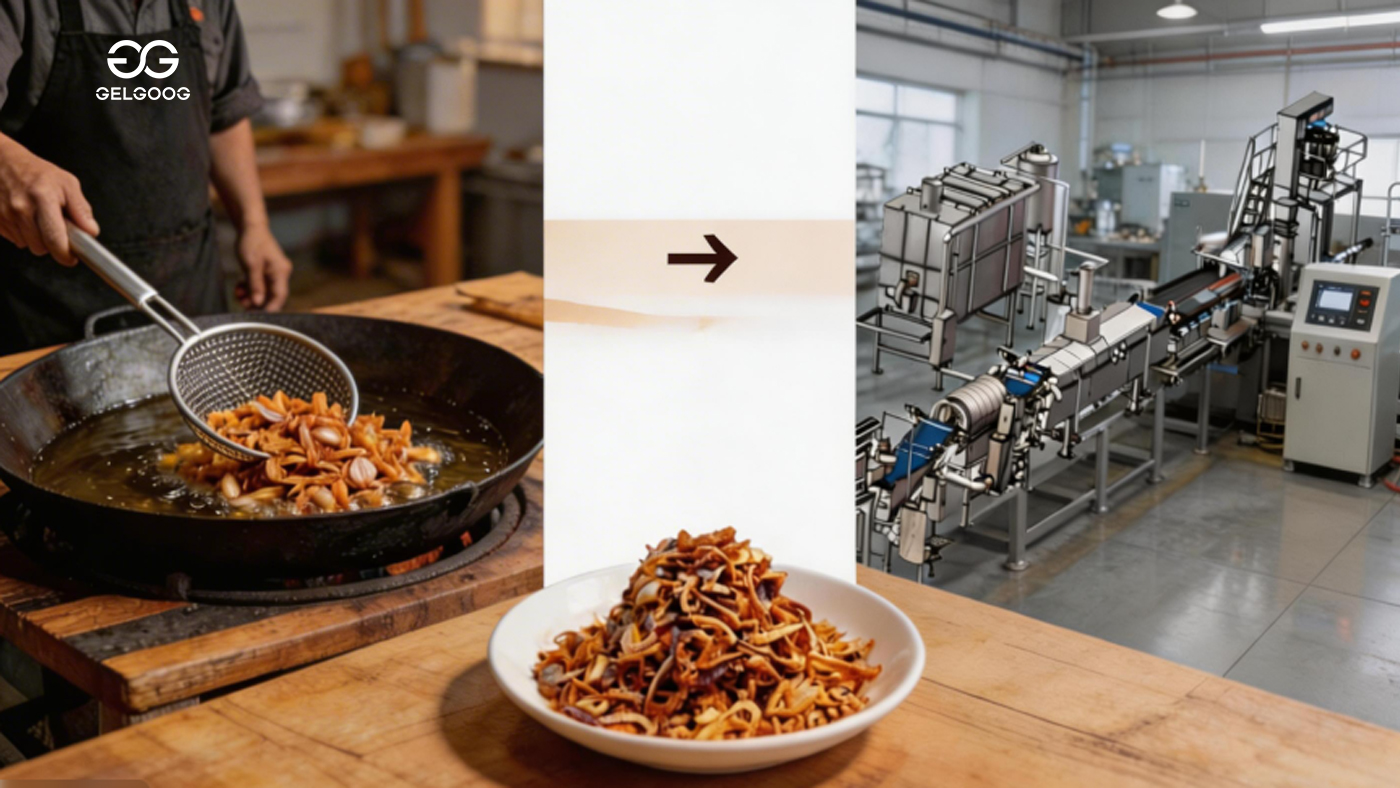
Scaling Up from Handmade to Factory Output — Automatic Onion Frying Machine Line
How to Scale up From Manual Work to Factory-Level Output
When Production Growth Becomes a Constraint Instead of an Advantage
In the early stages of an onion processing business, manual or semi-automatic production is often sufficient to meet demand. However, as order volumes increase and customers begin to expect stable quality and reliable delivery timelines, the limitations of this production model quickly become apparent.
This was precisely the situation faced by a Malaysian processor who had already established a functioning operation, producing approximately 1 ton per day using standalone machines and 15 workers. While the business was viable, the production system behind it was not designed for scale.
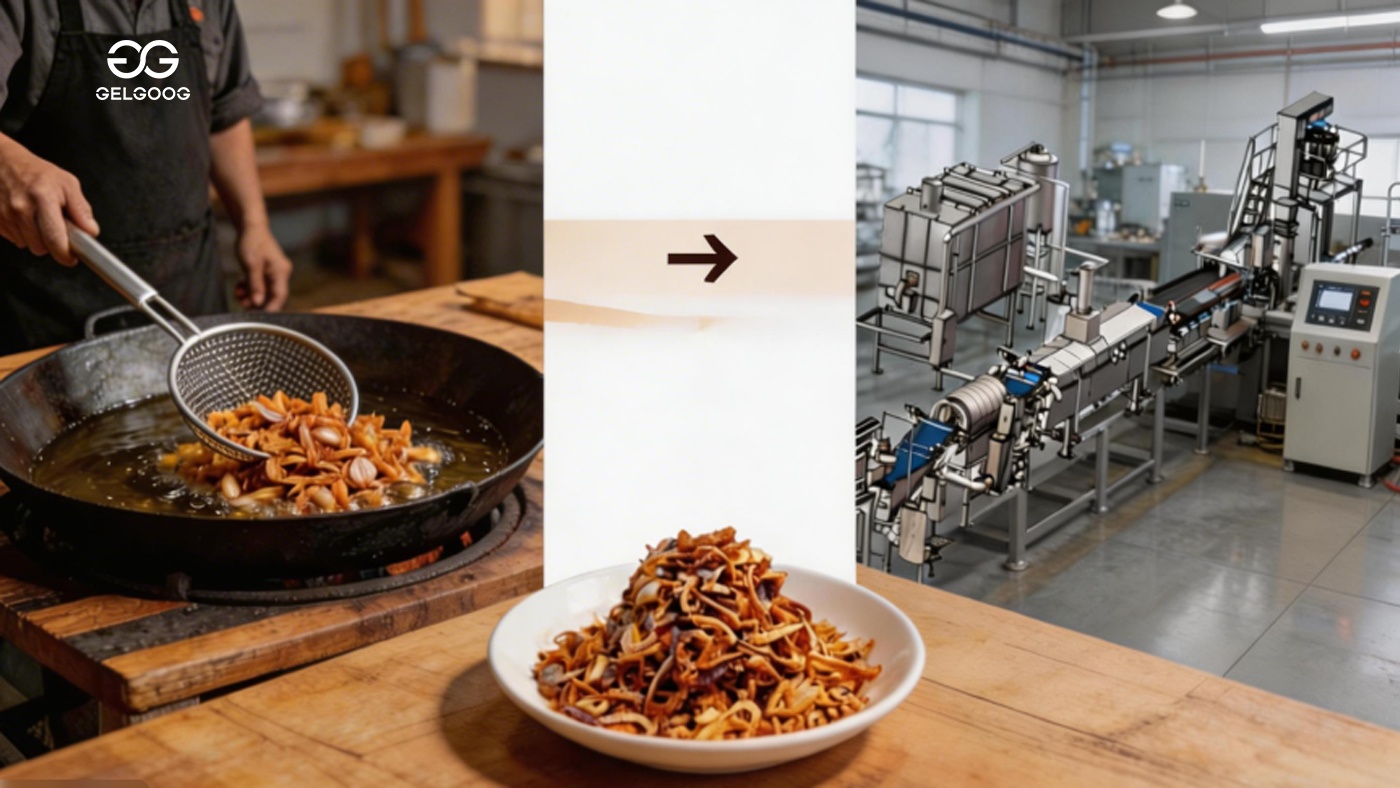
Why Manual Production Systems Fail at Industrial Scale
The core issue is not simply low capacity, but rather the absence of a continuous and standardized production onion process.
Labor dependency remains high: each processing step requires manual intervention, increasing operational costs and complexity.
Product quality becomes inconsistent: frying temperature, time, and handling vary between operators and batches.
Production flow is fragmented: preventing synchronization and limiting throughput.
These issues are common among small and medium processors transitioning to industrial production.
For a comprehensive guide, see: Onion Processing: Complete Industrial Guide to Onion Powder, Fried Onion & Onion Flakes Production
What Defines an Industrial Onion Frying Line?
An automatic onion frying line is not merely equipment, but an integrated system ensuring continuous operation, process stability, and scalable output.
Peeling and preparation
Washing and slicing
Continuous frying (160–180°C)
De-oiling and cooling
Final packaging
This setup eliminates bottlenecks and significantly improves efficiency and consistency.
Step-by-step guide: Fried Onion Production Process: Industrial Step-by-Step Guide
Case Insight: From 1 Ton/Day to 1 Ton/Hour
The Malaysian client’s objective was not simply to increase output, but to restructure production. Upgrade targets included:
Fully continuous automatic operation
Minimal operational team
Capacity: 1 ton/hour
The shift from labor-driven to system-driven production improved efficiency dramatically.

Key Operational Improvements After Automation
1. Significant Reduction in Labor Dependency
Automation reduced workforce by ~70–80%, with only 3–5 operators needed. This is crucial where labor costs are high or workforce stability is uncertain.
2. Standardization of Product Quality
Uniform appearance
Consistent oil content
Reliable quality suitable for export
3. Scalable and Predictable Production
Accurate production planning
Stable supply for large buyers
Easy expansion
For onion rings or other products: How to Build an Onion Ring Production Line for 2–5 Tons/Day Capacity
Energy Configuration: Critical Consideration
External fuel heating: suitable for limited electricity, cost-effective depending on fuel.
Electric heating: cleaner, precise, requires sufficient power supply.
Is It Time to Upgrade Onion Processing?
Labor costs rising without productivity gains
Difficulty maintaining product quality
Cannot meet growing orders
Lack of synchronized workflow
If yes, automation is a necessary step toward sustainable growth.
Conclusion: From Production to System Thinking
Transitioning from manual to automated onion processing reflects a shift from labor-driven to system-driven manufacturing—essential for scalable growth and export-quality consistency.
Get a Customized Solution for Your Factory
Process design and optimization
Equipment manufacturing
Factory layout planning
Installation and training
7×24 technical support